

Table of Contents
- Why Shoppers Are Looking Beyond Proud Poppy Clothing
- Proud Poppy vs Alternatives: Feature Comparison
- Inclusive Sizing Fashion Brands Australia: What to Look For
- Sizing Consistency Guide: How to Avoid Fit Disappointments
- Quality and Ethical Manufacturing: What the Labels Don't Tell You
- Personalized Styling Service Benefits for Your Body Shape
- How to Build a Capsule Wardrobe with Your New Favourite Pieces
- Final Verdict: Choosing a Brand That Fits You
- Frequently Asked Questions
Last Updated: September 5, 2026
Why Shoppers Are Looking Beyond Proud Poppy Clothing
When a fashion brand enters voluntary administration or faces liquidation, customers feel it first: pre-orders go unfilled, gift cards become worthless, and returns stall. That uncertainty is why many Australian women are weighing Proud Poppy Clothing against alternatives offering more retail stability and transparency. At Sandee Rain Boutique, we've watched this shift toward inclusive sizing fashion brands Australian shoppers can trust, and the pattern is clear: consumers want reliable order fulfillment and honest communication above almost everything else.

Hailey & Co Full Size Lace Detail Printed Blouse
The core issue reflects a broader sentiment demanding that brands prove garment quality and customer experience before asking for loyalty. If you've been burned by a brand that looked stable, you know the value of checking business registration, resale platform presence, and circular economy participation.
Below, we'll show you how to evaluate your options, what to look for in true size inclusivity, and how to build a wardrobe you won't regret. But first, here's what most guides get wrong: they treat "size-inclusive" as a single checkbox when it means very different things across brands.
Proud Poppy vs Alternatives: Feature Comparison
Most guides discuss alternatives in vague, anecdotal terms. This section takes a structured, feature-by-feature approach so you can weigh your options objectively. Instead of naming brands that may face their own challenges, we've built a framework based on the criteria that matter most when a brand's stability is in question.
How to Use This Comparison Table
Read across each row to see how a 'stable, quality-focused' brand stacks up against a 'higher-risk' one, then apply that lens to any label you're considering. This helps you cut through marketing language and focus on verifiable facts.
Feature |
Stable, Quality-Focused Brand (What to Look For) |
Higher-Risk Brand (Red Flags) |
Why This Feature Matters |
|---|---|---|---|
Size Range & Fit |
True inclusive sizing (e.g., 6-24+) with garments graded for curves; publishes separate measurements for curve and regular models. |
'One size fits most' or a limited range (e.g., up to size 16) that is just scaled-up straight sizing. |
Fit and silhouette depend on real pattern grading, not just a larger label. |
Fabric & Construction |
Detailed material composition (e.g., '55% cotton, 45% viscose') with clear care instructions; consistent quality across reviews. |
Vague 'premium fabric' claims without specifics; multiple reviews mentioning pilling, sheerness, or poor stitching. |
Textile durability and garment construction determine how long a piece will last and how it will look after a few washes. |
Business Stability |
Active trading, transparent about stock levels and lead times; clear information on business registration. |
Voluntary administration, liquidation sales, or a history of delayed or unfilled pre-orders. |
Order reliability and refund protection are directly tied to a company's financial health. |
Customer Service |
Responsive, personalised support via multiple channels (e.g., email, phone, live chat); known for resolving issues efficiently. |
No direct contact methods, slow or automated replies, or a history of unresolved complaints. |
Resolving size, colour, or delivery issues is critical for online purchases. |
Sustainability & Ethics |
Provides information on ethical manufacturing, supply chain partners, and circular initiatives (e.g., resale, recycling). |
No supply chain details or vague claims about being 'eco-friendly' without evidence. |
Brand transparency on ethics and sustainability aligns with consumer values and indicates long-term thinking. |
The 'Curve Model' Test: A Case Study in Transparency
A brand that publishes curve model measurements alongside regular sizing shows genuine commitment to inclusive fashion. For instance, the Hailey & Co range at Sandee Rain Boutique lists separate measurements for curve models (e.g., bust 47", waist 39") and regular models, showing garments are designed for different bodies, not scaled-up straight sizes. When evaluating an alternative, look for this detail in its size guide. A generic chart with bust/waist/hip for a 'standard' model suggests curve-specific grading may not be a priority.
A Note on Price as a Signal
Price is not always an indicator of quality, but extreme discounting can be a warning sign. A brand in financial distress may run deep clearance sales to generate cash flow, often from a final, possibly lower-quality production run. A stable brand will have consistent pricing that reflects its fabric and manufacturing costs. If a blouse is suddenly discounted, ask why, it might be a change in season, or a sign of deeper trouble.
Inclusive Sizing Fashion Brands Australia: What to Look For
The Australian market has grown more sophisticated about inclusive sizing fashion brands Australia shoppers can rely on, but the term still gets misused. A brand claiming size inclusivity should offer garments cut for curves, not simply label a size 18 as "XL" with straight-size proportions.
True Size Inclusivity vs Scaled-Up Sizes
True size inclusivity means the pattern is graded so each size maintains proportional fit across bust, waist, and hip. Scaled-up sizes simply stretch the original pattern, creating tight shoulders, gaping necklines, and uncomfortable waistbands. Look for size charts listing multiple body measurements rather than just a letter size, and garments shown on plus-size models, not just described.
Sizing Consistency Guide: How to Avoid Fit Disappointments
The most common complaint about online fashion is inconsistent sizing, often due to poor pattern grading. A sizing consistency guide starts with one habit: measure yourself fresh each season, because bodies change. Then compare your measurements against the brand's specific size chart, not your usual letter size from another label.
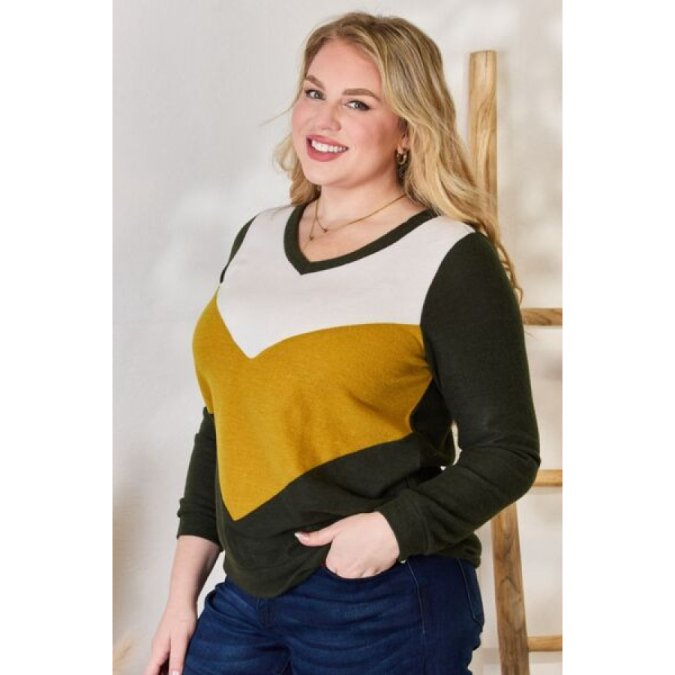
What most guides miss is that fabric composition changes how a size fits. A blouse with 55% cotton and 45% viscose, like the Pink Poppy Flower Striped Print blouse, will have minimal stretch and should fit true to your bust measurement. Something with spandex, like the Hailey & Co Full Size Colorblock V-Neck Blouse (95% polyester, 5% spandex), offers more give and can accommodate a slightly smaller size if you're between sizes.

Quality and Ethical Manufacturing: What the Labels Don't Tell You
Fabric composition is printed on the label, but the story of how a garment was made, and by whom, rarely is. 'Ethically made' is easy to claim and hard to verify, which is why supply chain transparency is a more reliable signal than any marketing slogan. Here's an objective breakdown of what to look for.

Hailey & Co Full Size Colorblock V-Neck Blouse
The Transparency Spectrum: From Opaque to Open
Brands generally fall into one of three categories regarding their supply chain:
- Opaque: No information is available about where or how garments are made. The only detail is 'imported'. This is the highest-risk category for both ethical concerns and quality control.
- Partial: The brand mentions a country of manufacture (e.g., 'Made in China' or 'Made in India') but provides no details on factory standards, audits, or worker welfare. This is the most common category.
- Open: The brand names its partner factories, publishes its code of conduct, and may share details on third-party audits or certifications (e.g., BSCI, WRAP). This is the category to prioritise.
The Fibre Story: Why Composition Is a Quality Signal
Fabric choice is a direct indicator of a brand's priorities. A 100% polyester blouse can be lovely for occasional wear, but it won't breathe like natural fibres and may not hold its shape or colour as well over time. Consider the following:
- Natural Fibres (Cotton, Linen, Viscose): Generally breathable and comfortable. Look for specific cotton types (e.g., 'Egyptian cotton' or 'Supima') as a sign of higher quality. Viscose, a semi-synthetic, can be excellent for drape but may shrink if not pre-washed.
- Synthetic Blends (Polyester, Nylon, Spandex): These add durability, stretch, and wrinkle resistance. A small percentage of spandex (3-5%) in a woven blouse can improve fit and comfort. However, a high percentage of polyester (e.g., 95%+) can feel clammy and may not age as gracefully.
- The 'Hand Feel' Test: You can't touch fabric online, but you can read reviews. Look for consistent comments about the 'hand feel', is it 'soft', 'scratchy', 'stiff', or 'buttery'? Multiple reviews describing the same texture give you a reliable sense of the fabric quality.
The Construction Checklist: What to Look For in Photos
Before you buy, zoom in on product photos to assess construction quality. Look for:
- Matching Seams: Do the patterns on the fabric match up at the seams? This is a sign of careful cutting and assembly.
- Reinforced Stress Points: Check the stitching around buttons, zippers, and armholes. Loose or uneven stitching here is a red flag.
- Finished Seams: Inside the garment, are the seams finished (e.g., overlocked or French seams) or are they raw edges that will fray? Finished seams are a hallmark of better quality.
The Australian Context: What 'Ethical' Means Locally
In Australia, there is no government-mandated 'ethical fashion' label; the industry relies on voluntary standards and consumer pressure. The Modern Slavery Act 2018 (Cth) requires large entities (revenue over $100 million) to report supply chain risks, but this does not apply to most small and medium-sized boutiques. The onus is on the consumer to ask questions.
Look for brands that are members of industry bodies like the Australian Fashion Council or align with the Ethical Fashion Report produced by Baptist World Aid Australia. While not a certification, a brand that openly discusses its supply chain transparency efforts is generally a safer bet than one that stays silent.
Personalized Styling Service Benefits for Your Body Shape
One of the most underrated personalised styling service benefits is having someone who can honestly tell you whether a print, cut, or colour will work for your proportions. With a small boutique rather than a faceless online giant, you get a real person who knows their stock and can guide you toward flattering pieces.
This matters even more for curvier women told for years that certain trends "aren't for them." A good stylist or boutique owner will help you find on-trend pieces that actually fit, rather than pushing safe, boring options. Feeling seen and understood is genuinely valuable when investing in wardrobe staples you'll wear repeatedly.
How to Build a Capsule Wardrobe with Your New Favourite Pieces
Learning how to build a capsule wardrobe doesn't require a complete overhaul. Start with versatile pieces in complementary colours, then add one or two statement items that bring you joy. The goal is fewer, better-quality garments that work together, perfectly aligned with sustainable shopping principles.
Choose a colour palette first. If you gravitate toward the vibrant patterns that boutiques like Sandee Rain Boutique specialise in, anchor them with solid bottoms in neutral tones. A floral print blouse becomes infinitely more wearable when it pairs with your existing jeans, trousers, or skirts, this versatility separates a thoughtful purchase from an impulse buy.
Final Verdict: Choosing a Brand That Fits You
When comparing Proud Poppy Clothing against alternatives, the decision comes down to what you value most: price point, size range, ethical manufacturing, or the peace of mind of retail stability. No single brand will excel at everything, but the right one will be transparent about its limitations.
For women who prioritise buttery-soft fabrics, inclusive sizing across a genuine range of body shapes, and personalised service that treats you like a person rather than an order number, Sandee Rain Boutique offers exactly that combination. Our exclusive custom designs and ethically made pieces are created for women of all sizes, with a 96% positive rating across 813 reviews. Whether you're after the Pink Poppy Flower Striped Print Blouse for $59.00 or a statement piece like the BiBi Tiered Ruffle Neck Zebra Pattern Top at $127.00, you'll find pieces designed to fit and flatter.

BiBi Tiered Ruffle Neck Zebra Pattern Top
The fashion industry is full of uncertainty, but your wardrobe shouldn't be. Choose a brand that values fit and silhouette as much as you do, one that will still be trading next season and the one after. Shop the collection and discover what happens when inclusive sizing, quality fabrics, and genuine care come together in every piece you wear.
Frequently Asked Questions
What are the best Australian-owned alternatives to Proud Poppy?
The best alternatives are brands that prioritise true inclusive sizing fashion brands Australia, not just scaled-up versions of smaller sizes. Look for labels offering extended size ranges (typically AU 6 to 26+) with consistent garment measurements. Boutiques like Sandee Rain Boutique provide detailed size charts in centimetres and inches for each product, so you know exactly what you are ordering. Independent Australian-owned labels often offer better customer service and unique designs than larger retailers, plus you are supporting local businesses.
How do I choose a clothing brand that offers inclusive sizing?
Look for three things: a size range that genuinely extends beyond straight sizes (AU 16+), garment measurements for every size rather than just S/M/L, and photos on models who reflect your body type. Many brands list a size range but cut larger sizes the same as smaller ones, which does not accommodate curves properly. Check if the brand offers a curve or plus-size fit specifically. Reading customer reviews about fit and fabric can also reveal whether the brand's inclusive sizing claims hold up in practice.
What are common complaints about Proud Poppy clothing?
Common complaints centre on business instability, with reports of orders being delayed or unfulfilled during periods of financial difficulty. Customers have also noted inconsistencies in sizing between different styles and quality concerns with some fabrics after washing. The brand has faced questions about its voluntary administration status, which has shaken consumer confidence. If you are looking for reliable order fulfilment and consistent garment quality, exploring alternatives with a stable retail presence and transparent business practices is a safer choice.
How do I know if a clothing brand's ethical claims are real?
Check for specific certifications rather than vague marketing language. Look for details about where garments are made, what factories are used, and whether the brand publishes this information openly. Australian brands should comply with local consumer law and modern slavery reporting requirements if they are large enough. Smaller brands often share their manufacturing process directly with customers through social media or product pages. If a brand cannot answer simple questions about its supply chain, treat its ethical claims with caution.
Is personalised styling service worth it for everyday fashion?
Yes, especially when you are investing in pieces you will wear regularly. A personalised styling service helps you identify silhouettes that flatter your specific body shape, saving you money on items that do not work. The benefits include receiving recommendations tailored to your lifestyle, colour preferences and fit requirements, plus honest feedback on what actually suits you. For busy women who do not enjoy shopping, a stylist can curate a cohesive wardrobe that mixes and matches easily, making getting dressed simpler every day.


Dejar un comentario